Showing posts with label LGBT. Show all posts

Wednesday, 23 June 2021

10 LGBT+ YouTubers to Watch this Pride Month

Happy Pride! As most of you are probably aware, June is celebrated as LGBT+ Pride Month all around the world, giving those of us in the LGBT+ community an opportunity to celebrate our identity (and giving companies an opportunity to slap a rainbow on their logo and earn some of that sweet, sweet pink money). Like many of us who are living in countries dramatically impacted by the COVID pandemic (i.e. pretty much everywhere), I am spending Pride 2021 cooped up in my home and consuming queer media in an attempt to make up for the lack of real-life events happening near me. This just so happens to be how I have spent almost every single pride since I came out, but I would rather blame it on COVID this year.

But if I can't experience queer community in real life right now, I can still do so through the internet. I have mentioned in a few past posts that I love watching YouTube, with many of my favourite creators being LGBT+. I thought that this month would be the perfect time to draw attention to some of these creators through one of my favourite mediums: a list.

This is by no means an exhaustive list (obviously there are more than 10 LGBT+ people on YouTube...), but these are ten of my absolute favourites - the kind I actually turn notifications on for because I'm genuinely excited when they put out a new video. That's right, I actually clicked the bell button for these people. 

I have done my best to research these YouTubers and make sure I've got their labels and pronouns right, but please do let me know in the comments if I have made a mistake and I will fix it ASAP. In some cases I have just not mentioned their specific identities, because while I know that all of the people on this list identify with the LGBT+ community, I am not sure which letter in specific they fall under. With all that out of the way, let's move on to the YouTubers!

Kat Blaque 

Kat Blaque is one of my all-time favourite YouTubers and probably the YouTuber I have followed most consistently for the longest period of time. While the content and style of her channel has evolved over the years, her honesty and charisma mean that she can make just about any topic interesting. Right now she runs a weekly True Tea podcast where she gives her opinions on a variety of subjects, from pop culture to social issues. She also speaks from her own experience as a Black trans woman, as well as someone who is involved in the BDSM, polyamorous, and goth communities of Los Angeles. Her perspective is always interesting and her sincerity is refreshing.

Tara Mooknee

Like Kat Blaque, I mentioned Tara Mooknee in one of my previous YouTube-related posts: 5 Video Essays I Love. That post mentioned Mooknee's video "The Rise of the Pick Me Girl Meme", which has over one million well-deserved views and which I would still highly recommend. That video is far from the only worthwhile video on the channel, though. Mooknee, a bisexual woman, primarily makes videos responding to things - "things" such as email chain messages, anti-lockdown propaganda, and cows in pop culture. Whatever the subject, Mooknee always manages to make her videos entertaining and absurdly funny while also breaking down the more serious aspects of her topics in an intelligent and insightful way. She also has an amazing fashion sense and an adorable dog named Siggy, so there's no reason not to watch her really.

Khadija Mbowe

Another YouTuber I've only recently started watch but love so far, Khadija Mbowe makes video essays about social issues and media. Their videos are consistently well-structured, researched, and presented, making them a pleasure to watch even when they go in-depth with serious topics. It's sort of hard to believe that they're actually a professional opera singer and not a full-time video essayist, but I suppose some people are just that multitalented! 

CopsHateMoe

CopsHateMoe is a non-binary YouTuber that I can't quite believe is only 19 years old, given how thoughtful and mature their video content is. They are somewhat involved in leftist spaces on social media, and they have previously been critical of those in leftist and LGBT+ spaces who perpetuate harmful behaviours, such as Xanderhal's ableism and Blaire White's take on pretty much everything. They recently became quite well known for their takes on the Kalvin Garrah situation, which has been a big topic among LGBT+ YouTubers of late. Their videos might have less appeal if you don't follow many creators in these spaces and thus have no idea what I'm on about, but if you do understand and haven't yet watched Moe's channel, I highly recommend that you do.

Jessie Gender

Like many of the other creators on this list, Jessie Gender makes commentary and video essays (my tastes are quite particular, as you can probably tell). Her videos tend to focus on geek culture seen through a socially critical lens. Many of these focus on Star Trek (Jessie Gender being a huge Trekkie), but she has covered others forms of media as well, from Marvel to Harry Potter. She often analyses these from her own position as a queer, trans, autistic woman, providing a much-needed perspective in geek fandom. 


MacDoesIt

If you're keen to watch more LGBT+ content but are more interested in watching funny videos than deep-diving video essays, MacDoesIt might be the channel for you. He describes himself as 'a satirical comedic vlogger who creates content that is a cross between “Intelligently funny” an “an organized hot mess.”' You might be familiar with his reaction videos, like his hilarious "Reacting to Anti-Gay Commercials Series". His style is energetic and sometimes chaotic, but in my opinion it's always funny (and judging by the 16 million views on his first anti-gay reaction video, I'm not the only one who thinks so).

Jessica Kellgren-Fozard

Another YouTuber who doesn't focus primarily on video essays, Jessica Kellgren-Fozard is a Deaf, lesbian YouTuber and vintage fashion icon. Her videos are fun and cheerful, including family vlogs (made with her wife, dogs, and newborn baby), vintage style tutorials, LGBT+ history lessons, discussions about disabled and queer identity, and more. Her style is impeccable and her attitude is contagiously upbeat. Fun fact: I actually learnt how to use foam hair rollers from her tutorial videos.

Philosophy Tube

Full disclosure: I didn't actually start watching Philosophy Tube until Abigail Thorn's relatively recent video where she came out as transgender: 'Identity: A Trans Coming Out Story'. That video was so mindblowingly good that I felt compelled to consume more of her work. So far, I have only become more impressed. Focusing primarily on issues of philosophy, as her channel name would imply, Philosophy Tube's videos tend to be highly-produced, aesthetically theatrical videos that are as thought-provoking as they are visually stimulating. I was particularly amazed by her recent video 'Ignorance & Censorship', which more or less made me reconsider my whole life.

Finnjamin Fox

Although his is one of the smaller channels on this list, Finnjamin Fox is definitely worth checking out. He makes sensitive, thoughtful videos about trans issues and his own experience as a trans, bisexual man. Like Tara Mooknee, he also has a very cute dog. The sense of calm and nuance that he brings to his videos makes them especially nice to watch. He always seems to approach his topics with compassion, which I find very admirable.

Samantha Lux

For the final YouTuber on this list, I would like to recommend Samantha Lux. She is a trans woman who creates videos where she reacts to current events and media from a trans perspective, as well as sharing her own experience transitioning. Her videos are well-researched and structured, even though they feel quite informal and fun too. I admire how well she balances humour and positivity with justified criticism of the often-transphobic behaviour she reacts to, and it makes her videos a joy to watch,

***

That's all for now! I could have gone on much longer with this list, but I decided that ten was a good number to stop at. I would be very happy to do a part two if that's something people would be interested in, though. My lists are obviously going to focus primarily on channels which appeal to my own specific tastes, so I would love to hear recommendations from other YouTube-viewers on the LGBT+ channels they enjoy. Please feel free to comment if you have any other suggestions of LGBT+ creators to watch this Pride!

Wednesday, 17 March 2021

Breaking Down the Homophobia Problem with Netflix's "Behind Her Eyes"

For the last couple of weeks, since its premiere in February, Netflix has repeatedly recommended the new series Behind Her Eyes to me. Billed as a psychological thriller revolving around a single mother who gets involved in the lives of a mysterious married couple, the six-episode series sounded right up my street. When I first watched episode one the other day, I wasn't sure it would live up to the hype Netflix had seemingly created around it. Then, as I watched the second episode (and the third, and the fourth, in a rapidly developing binge), I became hooked. Yet even while I kept speeding through the episodes, excited to find out what mind-blowing twists would be revealed next, I started to grow uneasy. I had a sense of foreboding, and not the kind the series wanted me to have, surrounding its representation of its one gay character. Having now finished the series, I am sad to say that Behind Her Eyes ultimately resorted to harmful homophobic tropes in its plot, albeit not the ones you might initially expect.

[WARNING - MAJOR SPOILERS BELOW]

Behind Her Eyes is a series that is largely driven by twists and mystery, so be aware that if you haven't watched the whole thing yet and you still decide to read this, the story may well lose a lot of its punch. Up until the final episode confirmed my worst gay fears about the show, I might have warned you more strongly, but now I can't bring myself to recommend it like I would have. So I now have no qualms about giving you a detailed rundown of the plot, spoilers included. If you've already seen the series and so don't need my explanation, feel free to skip to the asterisks below.
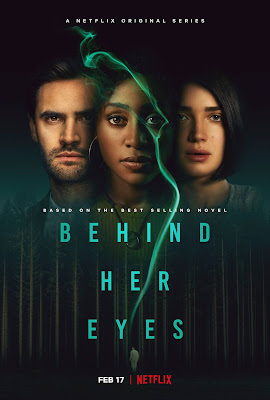
As I mentioned before, Behind Her Eyes focuses on Louise, a young single mother to an adorable son named Adam. One night, she hits it off with a handsome but painfully uncharismatic stranger at a bar, only to discover the next day that not only is this man (Dr David Ferguson) married, he's also the new psychiatrist at the clinic where she works as a receptionist. In spite of these minor obstacles, the two begin having an affair. Meanwhile, Louise strikes up a friendship with David's wife, Adele, who she literally bumps into on the street on the way home from her son's school. While Louise is drawn to and enjoys the company of both husband and wife, she soon begins to suspect something darker is going on. David and Adele's relationship seems full of paranoia and jealousy, with David actively controlling Adele by confiscating her phone and bank card, monitoring her location, and prescribing her drugs in spite of her protestations. 

We begin to learn more about Adele's backstory when she gives Louise a journal that supposedly belonged to her old friend Rob, a gay, working-class Glaswegian boy who she met during their stay at a rehabilitation clinic. Rob was in rehab for heroin addiction; Adele was there to recover from the trauma of a fire on her family estate, a fire which killed her parents and which she only escaped from at the last minute thanks to the help of David, her then-boyfriend. Adele gives Louise the journal to help with her night terrors, a condition which Rob also suffered from. With the help of the journal, Louise learns how to lucid dream her way out of her night terrors, becoming able to change her nightmares into whatever imaginary scenario she wants. We soon discover that Adele is able to use a similar technique to astral project, allowing her soul to temporarily leave her body and travel through the world in her sleep.

Around the same time, Louise's curiosity about Rob leads her to discover that he disappeared after visiting Adele's estate post-rehab. Adele says she believes David killed him, and it's clear from their interactions that she does indeed know a secret which David is afraid of people finding out. Flashbacks reveal that Adele is lying: David had nothing to do with Rob's death. What really happened is that Rob tricked Adele into swapping bodies during an astral projection outing, which Rob then took advantage of to force his original body into a heroin overdose. The result is that Adele's soul died in Rob's body, leaving Rob in possession of Adele's. Rob!Adele (as I will now be referring to Rob-in-Adele's-body) effectively took over Adele's life from this point onwards. He gains her wealth, her beauty, and her fiancé, all while retaining the ability to astral project which he learnt from Adele. This ability is put to use to spy on David throughout their marriage, allowing him to (among other things) witness David's affair with Louise first-hand. 

The climax of the film comes when Rob!Adele - through a convoluted scheme with another overdose and a house fire - gets Louise to astral project into Adele's dying body, while he takes control of Louise's. Louise's soul dies in Adele's body, leaving Rob now in the body of Louise. Rob!Louise continues Louise's relationship with David, becoming his new wife. The series ends firmly in horror territory with them driving off on their honeymoon, a miserable Adam in the backseat. 

***

Some of you reading might not immediately see the homophobic (and indeed transphobic) problems with this storyline, so I would like to explain. But first, let's talk a bit about perspective, a topic Behind Her Eyes incorporates so extensively. As a queer person, I always view media from a queer perspective. As someone who also knows a bit about tropes in media, I'm especially sensitive to depictions of queer characters that fall into LGBT-phobic clichés or stereotypes. 

Knowing this, you can imagine how Rob immediately caught my eye when his sexual orientation was revealed. My mind began spinning the roulette of gay clichés, wondering which one he might fit into. My first thought was that he was your classic gay best friend, perhaps not as offensively camp as your usual type but still a gay male character who exists solely to further the character development of a straight female one. Then, as flashbacks with Rob began to take on a more foreboding tone, I began to suspect he might be of the Bury Your Gays variety: a queer character is killed off with significantly more ease than a straight one because they're simply seen as more disposable. In the end, Rob turned out to be a perverse but equally cliched twist on both of these. He was a Depraved Homosexual, an evil gay whose sexuality seems to coincide with a total lack of morality (almost as if being gay were seen as immoral and thus serves as shorthand for showing us a character is fundamentally wicked - funny that).

Now I would like to stress that Rob simply being evil and gay at the same time doesn't make him a homophobic cliché (although if all your villains are gay and/or queer-coded then that's still a problem, but we can talk about that another time). The problem with Rob's character is that his evilness is specifically connected to his sexuality, with our anxiety over his potential to commit harm being tied to societal anxiety about queer people. His villainy is built on and supported by homophobia.

To show you what I mean by that, let's first look at Rob's relationship with Adele. For all he claims to love her, his actions are ultimately motivated by extreme jealousy towards her. In contrast to Adele, who is a heterosexual girl from a wealthy family with a loving boyfriend, Rob is gay, poor, and lonely. It's heavily implied that his depressing home life is the primary reason he uses heroin, even going so far as to say he'd rather stay in rehab with Adele than go back to live with his sister as he was before. He never mentions having any friends besides Adele, and the closest thing he has to a love life is exchanging sexual favours with a nurse for drugs. He even seems jealous of Adele's beauty, mentioning it frequently and saying he'd happily trade his life for hers. Thanks to combined astral projection and body snatching, that is exactly what he is able to do.
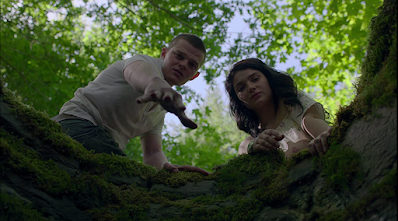
Pictured: Rob and Adele, Rob reaching desperately for a non-homophobic storyline

The way that Rob's motivations are presented here is extremely concerning as well as frustrating. A gay character being defined almost entirely by their relationship to straight people was always going to be dodgy, but having that definition come in the form of his being violently jealous of them is... a choice, at best. Rob's fascination with and eventual replacement of Adele brings to mind the idea that gay people are really just straight people trapped in the "wrong" body, secretly wishing they could be the gender that would make their attractions heterosexual. While this idea of queer people having the psyche of the "wrong gender" has previously been used in early gay rights movements (such as in the use of the term Uranian or Urning to describe gay men), it's now rightfully seen as outdated and offensive.

Rob's interactions with David are possibly even more worrying, seeing as they feed directly into the idea of predatory gays. From when he first meets David, it's clear that Rob is attracted to him. The feeling is not mutual, however, as David is straight and in love with Adele. Rob shows a blatant disregard for David's consent in this situation, even before he takes possession of Adele's body. He uses his astral projection to spy on David and Adele having sex, then does the same later on with David and Louise. The fact that he has sex with David in Adele's body is equally creepy, since David thinks he is consenting to sex with Adele rather than Rob. 

For those who aren't explicitly familiar with it, the predatory gay stereotype is based on the idea that gay people are such sexual deviants that they are willing to disregard consent if it means they get to have sex with the people they want. We are all just roaming would-be perpetrators of sexual assault, unable to control ourselves around people of the same gender. It is this idea which makes straight people afraid of sharing changing rooms or other same-gender spaces with queer people, having queer people near their children, or going into situations where the majority of people are gay and the same gender as them. Straight people think that gay people simply can't keep their hands to themselves and often believe that they, as heterosexuals, are somehow especially desirable targets for such perverts. It is, I hope it goes without saying, an enormously prevalent and harmful stereotype. It also appears to be the main basis of Rob's characterisation in Behind Her Eyes.

If I said that gay people are predatory, morally bankrupt people who destroy traditional (straight) families and can't be trusted around children, you could rightfully accuse me of peddling homophobic stereotypes. If I said that about Rob, the only gay character in Behind Her Eyes, I'd simply be describing him accurately. Therein lies the problem.

So Rob is a gay man who envies straight women and lusts after straight men, to the point of using manipulation and deceit to get what he wants. Clearly the depiction of Rob leaves a lot to be desired, but I would argue that when viewed from a thematic perspective, the homophobic implications of Behind Her Eyes get even darker.

Towards the end of the series, the tone shifts from that of a thriller to an outright horror story. It is important to note that horror stories frequently express anxieties that the audience can relate to, often societal anxieties, so that the story has greater power to disturb. Perhaps the greatest horror of Behind Her Eyes is the idea that you can never truly know someone, that a person who you love could really be somebody completely different to the person you thought they were. In Behind Her Eyes, this conflict leads to the destruction of a marriage (via Adele) and a family (via Louise). Somehow, the writers thought it was a good idea to make the destroyer of these two great institutions of heterosexual normalcy a gay character - the only gay character, at that. The hidden menace of the homosexual infiltrates pure straight life and corrupts it for their benefit... it's so blatantly problematic, it sounds almost as if they took inspiration from retro anti-gay propaganda.

Yet for all its implicit homophobia, Behind Her Eyes gives surprisingly little attention to Rob's identity as a gay man. The word "gay" is never even used, as far as I can remember. We only assume that Rob is gay based on references to his sex life - the first time he reveals his sexuality, it's when he declares himself to "prefer cock". All other mentions are similarly oblique and/or coarsely sexual. More than any other aspect of it, I thought that perhaps the isolation and loneliness which can come with being gay might at least come up, given how well it seems to fit into Rob's motivations for what he does. So why didn't they mention it?

My theory is that while devoting more attention to Rob and his LGBT+ identity would have possibly made the role less homophobic (simply in that it would make him a more multi-dimensional character whose sexuality goes beyond background casual sex), it would also have made the homophobia that was still part of his storyline more apparent. I imagine the writers were trying to create a character whose sexuality was incidental to their characterisation - if they drew more attention to his gayness, then it might seem like they were going out of their way to make the gay character the villain, thus making them more vulnerable to accusations of homophobia. Being homophobic is fine, of course, as long as you don't get called out on it.

But if Rob's character was indeed meant to be incidentally gay, why was he a man at all? Why didn't they make his role into that of a straight woman? I can think of very little that would have to change, plot-wise, for that to work. The female Rob would still be friends with Adele and be attracted to David. She could still come from a poor background, perhaps be less conventionally good-looking, and want to steal Adele's life from her. So why would the writers make the conscious choice to make this body-stealing villain not a straight woman but a gay man?

I can think of only one good reason why: Rob being male and gay is part of the horror. If you think I'm being uncharitable, remember what I said before about horror and social norms. Deviation from gender norms is commonly used in media to disturb, shock, or unnerve, such as in the case of the Unsettling Gender Reveal, the Creepy Crossdresser, or the Sissy Villain (read the TV Tropes pages for those if you don't know what I'm talking about). The Rob reveal is used similarly, to prompt viewers to say not only "Can you imagine if your wife was secretly someone else?" but "Can you imagine if your wife was secretly a gay man?"

This is what really drags the whole storyline over to transphobia as well as homophobia, as the horror the series is designed to evoke so strongly mirrors the fears bigots have about trans people: that they are deceitful and will "trick" cisgender, heterosexual people into sleeping with them. As a trope, this fits into Unsettling Gender Reveal, but it also recalls something known in real life as the "trans panic defence". This is a legal defence, based on the "gay panic defence", which a defendant can use to justify violence against a trans person if they had been sexually active with them before finding out they were trans. The idea behind it is basically that finding out that someone you've been with was not assigned the gender at birth which you expected can be so shocking that it can send someone into temporary insanity. It has been used, both in court and outside of it, to get away with violence against trans people (especially trans women of colour) time and time again.

I don't mention this to suggest that Rob is a transgender woman. I do not believe the writers intended him to be read in that way, nor did I interpret the series that way. However, intent isn't everything. Whether or not the writers intended it as such, Rob's queerness is fundamental to his villainy. In the anxiety he creates, we can see reflected societal anxieties about gender and sexuality, about the threat that gay and trans people pose to social norms. The story might be solidly fictional, but the real-world implications are not. 

Once again, I have no doubt that everyone involved with the production of the show will claim that it was not meant to be homophobic and that Rob's sexuality and gender were purely incidental. Yet on every level, the plot and Rob's involvement in it seem intensely problematic as well as cliched. The story's horror is propped up on homophobic stereotypes of predatory and dangerous LGBT+ people. If those involved in the creation of this show want to claim some part in the success of it, then they also need to claim responsibility for the harmful tropes it exploits. 

Wednesday, 24 February 2021

4 Short Book Reviews

For the last week or so, I've been on the kind of reading binge which normally only occurs when I'm on holiday and am somehow struck with an insatiable urge to consume as many books as I possibly can. I think the main trigger for this is the fact that my library membership is expiring soon, and as I won't be renewing it, this means that I have to read all the books on my library wishlist before I'm no longer allowed to borrow them.

Since I have been reading so much, I thought that for this week's post I would do a little reading round-up of all the books I've read recently. While not all of these were borrowed through my library, most of them were. Also, with the exception of Wuthering Heights, all of these were read in ebook format. With that out of the way, let's move on to the books.


Wuthering Heights by Emily Bronte

Ah, the Bronte sisters. Authors of those elusive classic novels which I somehow never get around to reading despite always claiming I intend to. Thanks to Wuthering Heights, I've been able to actually read a second Bronte novel (the first being Jane Eyre), despite buying my copy approximately a year ago. This was an intense, emotional, Gothic read which I highly enjoyed, although in hindsight I wouldn't recommend reading it while ill - every other character seems to fall ill with a minor cold and then die with very little notice. I think Wuthering Heights gets a bad reputation because Heathcliff is romanticised by some, but the book itself makes it pretty clear (to me at least) that the man is a definitely horrible person. Most of the other characters in the book even say as much. Anyway, I liked this book a lot and would love to do some literary analysis of it in the future.

Verdict: darkly fascinating and very dramatic - a Gothic romance legend

Something to Talk About by Meryl Wilsner

I've been seeing loads of hype about this book online, which seems to be one of a few F/F (female-female, for the uninitiated) romance novels which has gone rather mainstream. Of course other books like Carol and Oranges Are Not the Only Fruit have been successful too, but this one stands out as a light-hearted, fluffy love story in which there's little gay-related angst and no lesbians being killed. I sped through this novel in about a day, it was so easy to read and entertaining. Just a warning though: there is a sexual harassment plotline in here, which sort of makes sense given the Hollywood setting and it being published in light of #MeToo and #TimesUp, but it caught me a little off guard. 

Verdict: Very cute, very funny, and very gay.

The God of Small Things by Arundhati Roy

This is one of those contemporary "modern classics" which I've been meaning to read for ages but only just now got around to. I had high hopes for this novel based on Roy's reputation as a critically-acclaimed writer, and I'm happy to say it didn't disappoint. TGOST is the story of a wealthy but dysfunctional family in Ayemenem in India, focusing particularly on the lives of the twins Estha and Rahel. Themes of forbidden love (prohibited by the "Love Laws", in Roy's words), caste, and classism feature prominently alongside the importance of both the small and big things which impact us in our lives. I felt utterly immersed in the lives of Estha, Rahel, and their various friends and family over the course of the novel, an experience I didn't want to end even when it took devastating turns.

Verdict: Fluid, powerful, and heart-breaking - a justified modern classic.

Bunny by Mona Awad

Out of all the books mentioned in this post, Bunny is probably the weirdest. I read it because I saw it classed as a "dark academia" novel along the lines of Donna Tartt's The Secret History, but it reads more like a hallucinogenic combination of The Island of Doctor Moreau and Heathers, complete with both mean-girl cliques and human-animal hybrids. While it's definitely an interesting, reasonably inventive concept, in practice I didn't find it that fascinating beyond just a surface level "wow, that's kind of messed up". I'm not sure exactly what the author was trying to achieve (horror? comedy? bildungsroman?) so it's hard to judge if they managed to do it. The characters were too flat to be interesting, the satirical takedowns of artistic creator-speak got repetitive, and the ending took the punch out of the rest of the storyline. 

Verdict: Trippy enough to get a few entertaining conversations out of, but too muddled and vague to leave a lasting impression. 

So if you've made it to the end of this post, I will tell you a secret: this isn't actually all the books I've read recently. I just finished reading The Outsiders by S.E. Hinton and have started reading Tokyo Ueno Station by Miri Yu, but I obviously can't write about the latter yet and I feel it would be too rushed to add in the former now. Still, perhaps you can expect a post about them sometime in the near future. 

Until then, please let me know: would you read any of the books above? Which, if any, sound most interesting to you?

Tuesday, 28 July 2020

12 Songs About Gay Yearning (That Aren't by Taylor Swift)

Roughly a year ago, I got annoyed about Taylor Swift's release of a song called "You Need to Calm Down", which was being presented as something of a gay anthem at the time despite Swift being straight. I channelled this irritation into making a blog post listing five gay anthems performed by LGBT+ artists to listen to instead. Back then, I thought that was the probably last post I'd ever make about Taylor Swift - it turns out I was wrong.

Recently, my social media feeds have been filled with people discussing Swift's new song "Betty", which apparently can be generously interpreted as a queer love song. I'm holding myself back from going into a full-blown rant about why I think this is not the case (although I would happily do so in a later post if people are interested), because the song itself is not what I want to focus on here.

I've mentioned before that LGBT+ representation created by and for LGBT+ people is very important to me, and the release of "Betty" struck me as the perfect time to recommend some songs which might hold similar appeal to queer listeners (specifically in that they focus on gay yearning, a feeling many of us queers know all too well). The only difference is, these songs are actually by queer artists.

With all of that in mind, I compiled a playlist of twelve songs about gay yearning, all (with the exception of one, which I will explain later) performed by openly queer artists. By all means, continue to listen to Taylor Swift and "Betty", but consider also giving these songs a chance. You might just find your next great anthem for queer longing among them.

I've listed the songs below with embedded links to their YouTube recordings, or you can scroll to the bottom of this post for the Spotify playlist I've made. Happy listening!


"Jenny" - Studio Killers*

My research for this post has led me to conclude that, for many a queer, yearning = being tragically in love with your best friend. Despite its catchy techno beats, lyrically "Jenny" is about just such a situation.  Besides the original Studio Killers version, I would also highly recommend the heartbreaking Lily Sevin cover, which turns the song into a ballad.

Lyric of peak yearning: "I wanna ruin our friendship / We should be lovers instead"


"i wanna be your girlfriend" - Girl in Red

Of course the artist who is so gay that "do you listen to Girl in Red?" has become code for "are you gay?" would have done a song about the being-in-love-with-your-best-friend experience. "i wanna be your girlfriend" is about the singer's longing for their friend named Hanna, and it includes an iconic line which I can't include here in order to keep this post safe for work - you'll just have to listen to the song to find out what it is.

Lyric of peak yearning: "I don't wanna be your friend, I wanna kiss your lips"


Sleepover - Hayley Kiyoko

Another song about being in love with your friend - it's amusingly sad how common an experience this is for all of us. I'm starting to think that Hayley Kiyoko has made it her mission to write a song for every quintessential queer experience, from coming out ("Girls Like Girls") to not being sure if a girl is interested in you romantically or just physically ("Curious"). Either way, "Sleepover" is her take on the unrequited-best-friend-love trope.

Lyric of peak yearning: "Sleeping here right next to me / But will you ever mess with me? No / But at least I got you in my head"


Cherry - Rina Sawayama 

Unlike the previous songs, this one isn't about unrequited feelings for a friend (at least not explicitly). Rather, it's about finally facing up to your feelings for a girl and wondering if you can make the leap into that becoming a relationship. While I've included the original version on the playlist, Sawayama's piano version is definitely worth a listen as well.

Lyric of peak yearning: "Holding on to feelings / I'm not used to feeling / 'Cause, oh, they make me feel alive"


Boys Aside - Sofya Wang

Not only is this a great song about wanting to steal a girl away from the boys who want her attention, it also has a music video which is pure aesthetic goals. It's pastel, pink, and has an adorably tiny kitten in it. I'm not sure what else you could want.

Lyric of peak yearning: "I wanted you to be my baby girl tonight / And all the other boys could just say goodbye"


Flowers for Anna - Ames

This song has a smooth, dreamy sound that I really enjoy. The lyrics in "Flowers for Anna" are a bit harder to decipher than some of the other songs on this list, at least to me, but that just makes it more fascinating. It's also something of a hidden gem, with under 20,000 views on YouTube.

Lyric of peak yearning: "I've always been the weirdo / With flowers in my hands for Anna / Her little brother who liked me / I'd pretend he was her"


Girl - The Internet (ft. KAYTRANADA)

I wouldn't normally use words like "sultry" to describe a song, but this one fits the description perfectly. There is still a hint of uncertainty in the lyrics, though, when the singer tries to persuade the girl she likes that they should be together.

Lyric of peak yearning: "If I told you that you rock my world, I want you around me / Would you let me call you my girl, my girlfriend, my girlfriend?"


She - Dodie

This song goes back to the first step in many a gay journey, when you struggle to recognise your feelings for a girl and/or if it's even okay to have them. It's a little sad, but it's also tender and relatable.

Lyric of peak yearning: "I'd never tell / No, I'd never say a word / And oh, it aches / But it feels oddly good to hurt"


Pretty Girl - Clairo

Not all songs about yearning focus on a positive relationship, or even aspiring to one. "Pretty Girl" is about wanting someone so badly that you'd change yourself to be with them. It may be the negative side of the emotion, but it's yearning nonetheless.

Lyric of peak yearning: "It's getting harder to understand, to understand / How you felt in my hands, in my hands"


She's so Lovely - The Butchies

No, this isn't the Scouting for Girls song. This "She's so Lovely" is by The Butchies, a queercore band from America. Lyrically, it's about the ecstatic, urgent longing for a person you have a crush on.

Lyric of peak yearning: "She's a rocker dressed like a killer / She's got lips like wine not sugar / I'm running running into timing / Got a watch it's stuck in shining"


Bestie - Sizzy Rocket

You thought we'd reach the end of the list without another song about liking your best friend? I'm afraid not, my dear reader. This song focuses on the more physical side of things, and I should say that it's definitely not safe for work in terms of lyrics.

Lyric of peak yearning: "I wonder what, what, what does she want / What, what, what does she want"


What's It Gonna Be? - Shura

It may or may not be about a best friend, but either way this song is about having feelings for a person and not being sure whether to tell them. The music video is also a cute story of romance and friendships that takes on the archetypes of "The Jock, The Nerd, The Dork, The Popular Kid" - but with a queer twist, of course.

Lyric of peak yearning: "Do I tell you I love you or not? / Cause I can't really guess what you want / If you let me down, let me down slow"


*In terms of queerness, Studio Killers is a grey area because they're actually a virtual band, and I can find little-to-no information on the real-life artists behind the characters. However, it seems that the band's lead singer avatar, Cherry, is pansexual, so we'll just say this counts.

Sunday, 26 July 2020

5 LGBT+ Webcomics to Read Online Today

Most of you reading this post should be aware by now that I am a big fan of LGBT+ representation in media. I especially love media with LGBT+ people as the main characters, and what I adore with all my heart is when you have such media that not only stars LGBT+ but is created by LGBT+ people too!

Finding stories which fit this description can be a challenge, since queer and trans narratives are hard to find in mainstream media, let alone narratives written by people from our community rather than seen through a cishet lens. Thankfully, one area in which I've found a number of queer creators creating equally queer content has been webcomics.

For the uninitiated, webcomics are comics that are primarily, if not exclusively, published online. I like webcomics, and as you know I love LGBT+ content, so I thought I'd share with you five of my favourites. All of these prominently feature LGBT+ characters and are made by members of the community.

Just one note: some of these comics are not fully available online as they've now been turned into published, physical comics (hurray for queer success!). As frustrating as it is to have to stop a story partway through, I hope if you enjoy any of these you might feel inclined to buy the full book and help to support real-life queer creators who are giving us the representation we need. Anyway, on with the list!

The Tea Dragon Society by Katie O'Neill

When I first heard about The Tea Dragon Society, I thought perhaps I had stepped into an alternate reality where all my dream stories actually existed. The plot of this webcomic surrounds two girls who are introduced to the world of tea dragons - tiny dragons which produce tea! There's also friendship, queerness, and adorable little creatures (not just the dragons), all illustrated beautifully in light and natural tones. To top it all off, it's completely family friendly, so even young LGBT+ readers can enjoy it. If you like tea, cute things, or the idea of running off to live in a cottage with your girlfriend and your pack of animals, I highly recommend you read The Tea Dragon Society.

Status: complete, fully available online


Cosmoknights by Hannah Templer

Full of action and intergalactic adventure, Cosmoknights is about a band of misfits who roam space, rescuing princesses and being gay. The artwork is breathtakingly gorgeous and really gives a sense of the awe and excitement that the main character, Pan, no doubt feels when she takes off on her first outerspace adventure. This story has gladiators, strong women, futuristic space worlds, and a plot to take down the patriarchy. It also has one of my biggest fictional crushes at the moment, Cass (。♥‿♥。). Plus, I once tweeted about Cosmoknights and Hannah Templer literally replied to my tweet to say thank you, so how could you not want to support comics by a person as lovely as that?

Status: complete, partially available online


High Class Homos by momozerii

This is a newer comic for me, which I discovered through the webcomic platform Webtoons. I'd been sceptical about Webtoons ever since the Zuckerbot's hellsite started bombarding me with adverts for it, but once I started reading High Class Homos, all of my concerns about targeted advertising flew out the window and were replaced with love for this group of chaotic gays. High Class Homos, which arguably has the best title of all of these webcomics, follows a lesbian princess and a gay prince who decide to enter a lavender marriage with each other so they can keep being gay in secret. But even if those two give the series the "high class" part of its name, they are hardly the only homos. The story also includes their network of friends and love interests, most of whom are LGBT+ in some shape or form. While the setting is medieval and homophobia drives a good part of the plot, this webcomic is also incredibly funny. If you wish you could have a Disney princess story that also includes queer friendship and plenty of comedy, I would like to point you in the direction of High Class Homos.

Status: currently updating

(Note: I couldn't find a good photo of a "cover" for High Class Homos, so here is a poorly-embedded picture of Princess Sapphia that was posted on momozerii's Instagram)


Nimona by Noelle Stevenson

You might know Noelle Stevenson as the creator of the new She-Ra and the Princesses of Power TV series or possibly her Lumberjanes comics (both of which are very popular among the LGBT+ crowd, for good reason), but before either of those, I knew of her as the creator of Nimona. The eponymous main character of Nimona is a young shapeshifter and generally chaotic miscreant. One day she turns up at the door of supervillain Lord Ballister Blackheart and demands to be his sidekick, to which Ballister reluctantly agrees. As the story goes on, we get to see Nimona and Ballister's relationship develop, as well as learning more about Ballister's history with his nemesis Ambrosius Goldenloin. It's a funny, action-filled, and emotional story about acceptance and found family in a magical steampunk world. Looking back on Nimona now, it's especially cool to see how Stevenson's art style develops over the course of the series, and it's inspiring to know she has gone on to such success while still telling queer stories.

Status: complete, partially available online


Pandora's Tale by Xanthippe Hutcheon

Most of the stories I've mentioned so far have involved one of my favourite tropes (and one which I think is especially meaningful to LGBT+ folk), the ragtag bunch of misfits. Pandora's Tale is no exception, but in this webcomic's case, the main bunch of misfits has an added layer of coolness: they are also a branch of a resistance movement operating underground in a dystopian society. The titular character of the story, and the newest member of this band, is Pandora. She is a "helper", which is basically a mentally-programmed slave created to serve the upper classes of the society she is born into. After the people who train the helpers find out she is a trans girl, she escapes and ends up being adopted by the aforementioned resistance sect, including her new best friend, resistance member Isabelle. This is a story about dystopia and defiance that is also about identity and friendship, and it's also incredibly cute. I'd venture to say Pandora's Tale is less well known than the other webcomics on this list, but it is just as queer and endearing.

Status: currently updating


There you have it! Those are my top 5 LGBT+ webcomics. These are hardly the only ones out there, and I will admit that my choices are heavily influenced by my own preferences, both artistic and romantic. While most of these do include representation for other LGBT+ groups, most of these do clearly focus on relationships between women. If anyone else has any recommendations for LGBT+ comics that represent any other letters of the acronym, I would love to hear them.

I think that while mainstream representation is important, as a community we should also make a greater effort to support media that is created by and for LGBT+ people. We don't need to beg for scraps from the likes of Disney, Star Wars, and other media giants when fellow queer and trans folk are making the gay princess, trans space gladiator, queer tea dragon stories of our dreams. Let's try and support each other, in stories and beyond.

Sunday, 12 July 2020

Why J. K. Rowling is Not Our Ally

If any of you reading are fans of the Harry Potter series, supporters of the LGBT+ community, or just followers of book-related news generally, you are most likely aware that there has been something of a controversy surrounding HP author J. K Rowling in the last month or so. Essentially, Rowling has recently taken to Twitter to air her views on trans rights, which have been criticised by many as transphobia masquerading as feminism. As an LGBT+ person who has long been a fan of Rowling and has previously written about the importance of the Harry Potter books in my life, I wanted to write a post explaining my views on the situation.

First of all, I would like to stress that while it has only been recently that Rowling's anti-trans Twitter tirades have hit mainstream news, people in the LGBT+ community have long suspected her of holding transphobic views. As far back as March 2018, Rowling was liking tweets that referred to trans women as "men in dresses" - an action which her representatives blamed on a "middle-aged moment" at the time. Many of us had been keeping a sceptical eye on Rowling's social media activity since then, and we watched as she slowly began to move from liking transphobic tweets, to retweeting them, to finally writing her own.

This eventually culminated in Rowling publishing a post on her website, explaining her "reasons for speaking out on sex and gender issues". I'm not going to link to the post here, but it's easy enough to find if you want to read it for yourself. The purpose of the post, I imagine, was three-fold: to justify Rowling's recent statements regarding trans issues, to elaborate on her "gender critical" views, and to condemn critics who correctly identified her views as those of a TERF (Trans-Exclusionary Radical Feminist). It also showed many of us why Rowling has historically stuck to fiction writing, although I doubt that was one of her goals in writing the essay.

I am not going to explain, in detail, why the things Rowling said are transphobic and harmful. This is not only because many other people, including many trans activists, have broken this down far better than I could, but also because her views are hardly unique. The ideas that trans women are a danger to cis women's safety, that acknowledging the difference between sex and gender will diminish the importance of reproductive rights, and even that supporting transition is in some way supporting a new form of conversion therapy - these are nothing new. Yet the fact that these views are being espoused by someone as influential as Rowling is worrying. Still, as I said, I am not going to get into much detail about that here. I am linking to other informative articles throughout this post, and I will leave a number of links for further reading at the end of it.

All of that said, there is one aspect of Rowling's vitriol which I would like to address, and that is the way she has been referring to queer women. When Rowling mentions cis queer women, she leaves the "cis" unspoken, despite the fact that trans people are more likely to identify as non-heterosexual than those who are cisgender. Rowling's exclusion of this is crucial, as she has recently taken to using cis queer women as human shields in her one-person war against trans people. The first example of this naturally took place on Twitter, on 7th June, when Rowling wrote a post claiming that "If sex isn't real, there's no same-sex attraction", which she soon followed by sharing an article by a lesbian woman who claimed that the LGBT+ community's support of trans people was leading to lesbians being "shouted down" and ignored.

Now, I'd like to quickly point out two things. First, I don't know of a single trans activist who claims that "sex isn't real". All I have ever seen trans activists advocate for which Rowling could possibly be confusing for this is the idea that we should update our perceptions of sex and gender so that they are in line with the most current scientific understanding: that sex is not binary and it is not the same as gender. Secondly, while there are small numbers of queer women who are indeed TERFs (though they apparently don't like to be labelled as such) and don't support trans people, I believe that the majority of us understand that trans people have historically been and continue to be integral to our community. So why, if she has studied trans literature to the extent that she claims, would Rowling choose to focus on a fringe branch of the community despite it not being reflective of the broader group?

The reason, to put it idiomatically, is because Rowling wants to have her cake and eat it too. She wants to be able to continue claiming she is an LGBT+ ally while still promoting her transphobic agenda, and the way she has decided she can do this is by presenting the conflict as lesbians vs trans people, with her on the side of the former. This is terribly convenient for Rowling, who can then deflect any criticisms from the LGBT+ community with quotes of one of the few queers who agrees with her or tweets referencing one of her "best mates" who is a "self-described butch lesbian". The shallowness of it all is almost comical. "I'm not homophobic," she might as well have said, "I have a gay friend."

For anyone who doubts that Rowling's supposed LGBT+ (minus the T) support is anything but self-serving, I would like to ask this: would a true ally have written an entire seven-book series without including a single openly-LGBT+ character? Would they have sloppily claimed, post-publication, that one character had actually been gay? Would they have then later, when given the opportunity to make this queerness explicit in film adaptations featuring said character, have chosen to reference it only in vague allusions that would easily be ignored or censored by homophobes who preferred to pretend they hadn't seen it? If Rowling is such a supporter of lesbians, where were the lesbians in Harry Potter? I could be wrong, but I don't recall a single one.

But perhaps, you might argue, she can be an ally without necessarily putting representation in her work. To which I would say, we do not owe Rowling our support as an ally. She does not deserve it simply for claiming she has a gay best friend or once sharing a shallow, rainbow-tinged reference to Harry Potter on social media. If she truly cared about us, she would have put us in her books. She would have donated to charities which supported us. She would have promoted books by other LGBT+ authors. Has she ever done any of these? Furthermore, if she has, has it ever been on anything close to the scale at which she has voiced such disrespect for trans people? The answer is no, because Rowling doesn't care about LGBT+ voices unless they are speaking up in support of her.

I have hesitated to write this post for a while, feeling that adding my voice to those who are speaking out against Rowling was unnecessary at best or speaking over trans people at worst. It was one comment, among many which angered me, that infuriated me to the point of wanting to finally write this. It was Rowling's assertion, which she has in fact made a number of times now (as many other TERFs have done before her), that transitioning is akin to conversion therapy. Her idea seems to be that young queer people are being forced to transition rather than being allowed to accept their queer identity. This idea is absolutely ludicrous. If trans people, as we have established, face transphobia even within the LGBT+ community, then how do you expect us to believe that trans people are now magically more accepted than queer people? I have never in my life met a person who accepted transness but not same-sex attraction; far more often I have met people who supposedly support the LGBT+ community, but who don't accept the T part of the acronym. For Rowling to then make this absurd claim is not only silly, it's disgusting. It is repulsive to me that she would take an experience which has caused so much harm to so many young queer people (and, yes, trans people too!), which she as a cishet woman knows nothing about, and use it to support her own hateful position. A true ally would never do something like that, and the fact that Rowling would shows to me that she never truly supported us at all.

Let me make this very clear. Rowling does not represent the views of queer women. She is not our ally, and she certainly does not have the right to be using us to deflect from criticism of her transphobic agenda. Our trans siblings have more in common with us than a self-serving, cishet faux-ally like Rowling ever will. I am disgusted at Rowling's attempts to co-opt queer women's struggles. What I see in these attempts is that Rowling will go along with a tide of LGBT-phobia as long as she can position it as feminism. I am not oblivious to how much of the anti-trans discourse mirrors old-fashioned homophobia - does Rowling think we don't remember hearing that queer women were threats to straight women, that we shouldn't use the same bathrooms because of our inherent perversity, that we were harmful to the feminist movement? I've heard it all before, and changing your target from cis queer women to trans women has not deceived me. I know that if J. K. Rowling were a prominent feminist only a few decades earlier, she would have directed this same hate at the queer women she claims to support. I hope that every other cis queer woman sees her fake support for what it is: a flimsy attempt to keep herself from being seen as the LGBT-phobe she is.

So, what now? Where do those of us who have spent large parts of our lives loving the HP books (and even, as in my case, Rowling's post-HP writing) go from now? Personally, I will no longer be supporting J. K. Rowling. I have many happy memories connected with Harry Potter, but I know that these are not solely because of the books themselves. I mentioned in my previous post about HP that the books reminded me of home and of my family. I still have those things, and I don't need Harry Potter to maintain their importance to me. Privately, the characters and their stories will likely always hold some sentimental value for me of course, but I will no longer be promoting the books to new readers, buying Harry Potter merchandise, or reading any of Rowling's new books. Instead, I will be trying to support writers of fantasy and children's fiction who don't have Rowling's influence, especially those from marginalised groups, such as trans authors. I will try to lend my support to those authors who deserve it, who will use their influence for good instead of causing harm. Harry Potter has indeed been important to me, but supporting my friends in the LGBT+ community is more important than that. I hope that those of you reading feel the same.

***

As I mentioned earlier in the post, I think that the people we need to be listening to most at the moment are those most affected by the situation: trans people. To that end, here are some links to content by trans creators on this subject which I have found informative. I would encourage you to explore these and seek out more perspectives by trans people wherever you can.

Sunday, 5 July 2020

A Book Everyone Hated but I Liked // 30-Day Book Challenge - Day 29

Today is the twenty-ninth day of the 30-day book challenge, in which I will be writing about a different book or book series every day for 30 days, with each book chosen according to the daily prompt. Today's prompt is: "a book everyone hated but you liked".

[Note: So I actually wrote this post about a month ago and was ready to post it, but given everything that has been happening around the world lately, it didn't seem quite right to post my frivolous book posts at a time when far more important things needed people's attention. That's why this post is so late and also why it lacks a proper introduction, as I had to delete the original, now-irrelevant one.]

Fun fact: This post marks the third in a row which focuses on a book with LGBT+ themes. Previously, we had the twisty novel Fingersmith and the poignant essay collection Sister Outsider. Today these two are joined by another novel, My Education by Susan Choi.


The plot of My Education, as explained by Goodreads, is as follows:
Regina Gottlieb had been warned about Professor Nicholas Brodeur long before arriving as a graduate student at his prestigious university high on a pastoral hill. He’s said to lie in the dark in his office while undergraduate women read couplets to him. He’s condemned on the walls of the women’s restroom, and enjoys films by Roman Polanski. But no one has warned Regina about his exceptional physical beauty—or his charismatic, volatile wife.

My Education is the story of Regina’s mistakes, which only begin in the bedroom, and end—if they do—fifteen years in the future and thousands of miles away. By turns erotic and completely catastrophic, Regina’s misadventures demonstrate what can happen when the chasm between desire and duty is too wide to bridge.
So before I get into why I liked the book, let's address the first half of this prompt: why everyone hated it.

My Education seems to be nothing if not contentious, and not necessarily for the reasons you might expect. On a certain online shopping website that shall remain nameless but which you definitely know of and definitely begins with an A, My Education has an average rating of 3.4 stars out of 5. The distribution of reviews for each star rating is as follows:


Its ratings on Goodreads are a similar story, albeit with a greater proportion of reviews sitting around the middle of the scale, around 32% of these being rated 3 stars out of 5. Here is a chart of these ratings which I shamelessly stole from the Goodreads website:


So why the dislike? To get an idea of what people don't like about My Education, I have selected a few choice quotes from online reviews of the novel:

  • "boring inarticulate book"
  • "UNINTERESTING COULD NOT FINISH AS COULD NOT CARELESS WHAT HAPPENED"
  • "how did this get published?"
  • "one of the most boring and distasteful books that I have ever had the misfortune to read"
  • "too wordy"
  • "None of the characters are likable or sympathetic"
  • "achingly dull"
  • "overwrought [...] exaggerated and pretentious"
  • "Hated, because annoying inconsistencies. Annoyed, because grammatically complex and faddy."
  • "spectacularly bad. Overwritten, barely sensical in its flow, frivolous."
  • "selfish, self-absorbed, whiney characters."
On top of the above reviews, I also saw a comment on Autostraddle refer to it as "A TERRIBLE TERRIBLE BOOK". Considering Autostraddle is where I first heard about My Education, that one stung especially badly.

Beyond the general complaints that My Education is just a generally awful, objectively terrible book, I think there are three major complaints among its negative reviews: the book was boring, its writing was overdone, and the characters were unlikable. In order to best defend the novel, I'm going to go through these points one by one and explain why I don't agree with them and why I actually like the book, its plot, and its characters.

First of all, the writing. Ignoring the plot and characters for the minute, the most controversial aspect of My Education seems to be its writing style. A lot of this comes down to personal taste, but I would disagree with other reviewers' statements that the writing is "too wordy" or "barely sensical". I enjoyed the flow of the writing, its use of unusual words (the second page of the book alone gives us "esoterica" and "stultification"), and the expressive, detailed prose. If at times it veers slightly into pretention, I took that as a representation of the not wholly-likable main character (a graduate student attempting to fit in among the lives of successful academics) and her mindset at the time.

As for the book's characters and plot, I feel that these two must in some way be analysed together, as the book's plot revolves almost solely around the emotions and personal conflicts of its characters. This is not a book with events on the scale of saving the world or even having an impact on a community - most of its plot has its impact limited to three characters, perhaps five at a stretch. If you are disinterested in these characters and thus are not invested in the personal stories, the book's plot will naturally not be of interest to you either.

In my case, I found the plot intriguing because I found the characters to be so as well. None of them are intended to be likable, as some readers were disappointed to find out. They are deeply flawed people who make terrible mistakes. Yet for all the blurb seems determined to paint Brodeur as some sort of sexual predator, none of the characters are that far beyond redemption. They are tragically human people, whose desires and skewed moralities lead them to make equally tragic decisions. I understand that sort of plotline might not appeal to all readers, but I found it fascinating.

The funny thing about writing this post, and reviewing all of the negative things people have said about my chosen book, is that it made me question my own judgement of the book. It's been a while (a couple of years, to be precise) since I last read it, so I am not so well equipped to argue its merits as I would be had I read it only recently. However, the memory of loving the book when I first read it is still strong in my mind. Perhaps if I were to read it again today, with all of these criticisms lurking in my subconscious, I wouldn't enjoy it so much. Still, that doesn't change the fact that when I read it I felt as positively about it as many other people felt negatively.